Web Dashboard & REST API
Web Dashboard
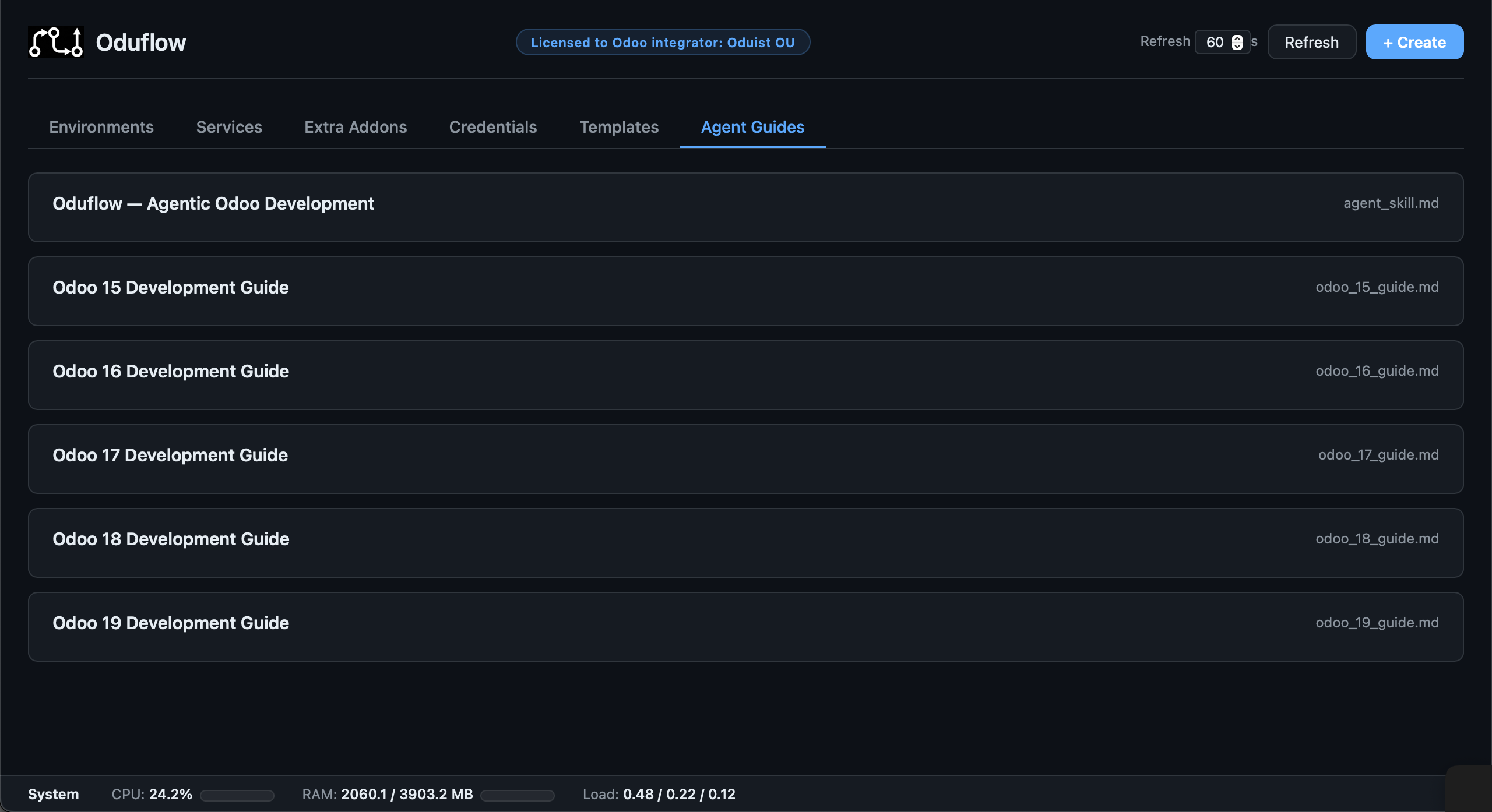
HTTP mode serves the dashboard at /. It manages environments, templates,
services, volumes, extra addons, credentials, licenses, usage/quotas, and—when
enabled—coding agents and productions. Environment cards also expose logs,
Odoo/SQL terminals, Connect As, notes, protection, scoped MCP access,
single-environment share links, and save-as-template actions.
The header's Feedback action opens a prefilled issue form on
github.com/oduist/oduflow. Oduflow holds no GitHub credentials and files
nothing itself: it builds the link with the description and a short
version/platform/transport block, then the user reviews and submits it from
their own GitHub account.
Authentication and responses
Dashboard API routes use the authenticated UI session (user admin, password
from [team.*].ui_password). The login form creates an HTTP-only session
cookie; HTTP Basic credentials are also accepted. State-changing cookie-auth
requests and all WebSocket handshakes are protected by Origin/Referer checks.
This authentication is separate from MCP Bearer authentication.
Most REST handlers return JSON containing ok. Three public surfaces use their
own security model:
/healthzis unauthenticated and contains no secrets./api/webhooks/githubverifiesX-Hub-Signature-256against the production webhook secret.- Odoo.sh import ingest routes require a short-lived Bearer import token. The token-minting endpoint remains UI-authenticated.
/oduflow-connect is a one-time, token-authenticated browser redirect rather
than a JSON API. Production routes are registered only when
[production].enabled = true.
Environment endpoints
| Method | Endpoint | Description |
|---|---|---|
GET |
/api/environments |
List environments |
POST |
/api/environments/create |
Create an environment. Body: env_name, optional hostname, repo_url, odoo_image, template_name, extra_addons, auto_install_modules, env_vars (merged per key over the template's), git_user |
POST |
/api/environments/{branch}/start |
Start an environment |
POST |
/api/environments/{branch}/stop |
Stop an environment |
POST |
/api/environments/{branch}/restart |
Restart its Odoo container |
POST |
/api/environments/{branch}/sync |
Pull and automatically apply code changes |
GET |
/api/environments/{branch}/modules |
List installed modules (name and version) — the source for the dashboard's Upgrade modules picker |
POST |
/api/environments/{branch}/modules |
Install or upgrade modules. Body: action (install or upgrade), modules (comma-separated string). A successful action returns modules_installed or modules_upgraded plus container_restarted; if the follow-up restart fails, the module action remains successful with container_restarted: false plus a warning. Every result includes modules_attempted; a non-zero Odoo exit code omits the success field and includes the command output |
POST |
/api/environments/{branch}/switch-branch |
Move the environment onto another git branch, keeping DB, filestore and URL, then apply the difference. Body: branch, optional new_name to rename the environment at the same time. The response's env_name is the name to address it by afterwards |
POST |
/api/environments/{branch}/update |
Recreate the container while preserving DB and filestore. Optional body: env_vars (full replacement of the user-supplied container variables — either an object mapping names to values, or a KEY=VALUE string separated by newlines or commas; an empty object/string clears them, an absent key keeps them). The dashboard sends an object, so a value may contain commas, odoo_image, new_name (rename the environment; a pooled or explicit hostname is kept, its scoped MCP endpoint moves to /mcp/<new name>; productions and stack members are refused) |
GET |
/api/environments/{branch}/env-vars |
Return the user-supplied container environment variables |
POST |
/api/environments/{branch}/recreate |
Delete and recreate with the recorded parameters |
POST |
/api/environments/{branch}/delete |
Delete the environment |
GET |
/api/environments/{branch}/logs?n=200&container= |
Read environment logs; optionally select a container |
POST |
/api/environments/{branch}/protect |
Protect from stop/delete |
POST |
/api/environments/{branch}/unprotect |
Remove protection |
POST |
/api/environments/{branch}/note |
Store the body note on the environment |
POST |
/api/environments/{branch}/storage/refresh |
Refresh cached DB/workspace sizes |
GET |
/api/environments/{branch}/mcp-access |
Return the scoped MCP URL and per-environment token |
GET |
/api/environments/{branch}/share |
Return the environment's share link status: shared, url (with its key) and created_at |
POST |
/api/environments/{branch}/share |
Start sharing the environment, or return the existing link |
POST |
/api/environments/{branch}/share/rotate |
Issue a new link; the previous one and every session opened with it stop working |
POST |
/api/environments/{branch}/share/revoke |
Stop sharing the environment |
GET |
/api/environments/{branch}/users |
List internal and portal users for Connect As |
POST |
/api/environments/{branch}/connect-as |
Mint an Odoo session for body user and return URL/cookie details |
GET |
/api/environments/{branch}/connect-open?user= |
Mint a session and redirect toward the environment login handoff |
POST |
/api/environments/{branch}/save-as-template |
Save the environment under body template_name; the UI never overwrites an existing template |
Branch parameters use Starlette's path converter internally, so names that
contain / are accepted and URL-decoded as one environment name.
The four share routes are operator-only: a shared session cannot read, reissue
or revoke the link it arrived on. See
Shared environment links.
Shared environment links
/env/{name} is the same dashboard reduced to a single environment. An operator
opens Share UI on an environment card, which mints a link
https://<team-host>/env/<name>?key=<secret> and hands it to a client. Opening
it exchanges the key for an HTTP-only, SameSite=Strict cookie and redirects to
the clean /env/<name>, so the key leaves the address bar and browser history.
The link stays valid until it is regenerated or revoked from the same modal;
both act immediately on sessions already opened with it.
A shared session may only do the following, enforced server-side as a
default-deny allowlist (src/oduflow/ui_scope.py) and re-checked on every
request:
- see that environment's card, status, storage and logs;
- start, stop, restart and sync it, and install or upgrade modules;
- open its Odoo shell and
psqlconsoles, use Connect As, and read its scoped MCP endpoint and Secret Key; - use Agent Chat.
Everything else is refused with HTTP 403 (WebSockets close with 1008): the full dashboard, any other environment, every team-wide surface (templates, services, volumes, extra addons, credentials, productions, host statistics, license), the provisioning actions on the shared environment itself (create, delete, update, recreate, switch branch, protect, save as template), the share routes, and Agent CLI.
Agent CLI is excluded because it is a terminal in the per-team agent
container, whose workspace holds a checkout of every environment of the team.
Agent Chat runs in that same container, so the scope of a shared link is a
policy boundary on the dashboard — it is not the cryptographic confinement that
the per-environment token gives on /mcp/<env>. Share links with people you
would let work in the environment.
Environment WebSockets
| Protocol | Endpoint | Description |
|---|---|---|
WebSocket |
/api/environments/{branch}/terminal |
Interactive odoo shell terminal |
WebSocket |
/api/environments/{branch}/sql |
Interactive psql terminal using the environment-scoped DB role |
WebSocket |
/api/environments/{branch}/agent |
Hosted Agent CLI PTY |
WebSocket |
/api/environments/{branch}/agent-acp |
Hosted Agent Chat ACP relay |
Templates and Odoo imports
| Method | Endpoint | Description |
|---|---|---|
GET |
/api/templates |
List template profiles |
GET |
/api/templates/{name:path}/metadata |
Read the complete metadata.json content and its optimistic revision |
PUT |
/api/templates/{name:path}/metadata |
Validate and atomically replace metadata.json; body: content, revision |
POST |
/api/templates/{name}/delete |
Delete a template |
POST |
/api/templates/{name}/rename |
Rename it; body: new_name |
POST |
/api/templates/import-from-odoo |
UI-authenticated: pull a backup from a running Odoo. Body: odoo_url, master_pwd, template_name, optional db_name, optional boolean without_filestore |
POST |
/api/templates/import-token |
UI-authenticated: mint a 15-minute Odoo.sh import token |
GET |
/api/templates/import/status |
Import-token authenticated: report resumable upload progress |
POST |
/api/templates/import/manifest |
Upload template metadata |
POST |
/api/templates/import/dump |
Stream/chunk the compressed SQL dump |
POST |
/api/templates/import/filestore |
Upload one atomic filestore hash-directory archive |
POST |
/api/templates/import/addon |
Stream/chunk one private addon archive |
POST |
/api/templates/import/addon-remote |
Register an addon repo that the server can clone |
POST |
/api/templates/import/finalize |
Validate staged data and atomically publish/restore the template |
GET |
/import-odoo.sh |
Download the token-authenticated Odoo.sh import client |
The pull-import endpoint accepts HTTP and HTTPS source URLs. HTTP sends the Odoo master password without transport encryption, so HTTPS remains recommended. Loopback, link-local, metadata, and private-network targets remain blocked by the outbound URL safety check.
Odoo.sh ingest endpoints accept the import token only in
Authorization: Bearer ..., not in the URL. See
Template Management for the supported import workflow.
Services, PostgreSQL databases, presets, and volumes
| Method | Endpoint | Description |
|---|---|---|
GET |
/api/services |
List services |
POST |
/api/services/create |
Create a service with either catch-all port or restricted Traefik routes, plus optional image/runtime settings. command accepts a shell-quoted string or an argv array and replaces the image CMD |
GET |
/api/services/{name}/env-vars |
Return the environment variables an update keeps — the saved preset, or the container's own environment for a service created before presets |
POST |
/api/services/{name}/update |
Pull/change settings and recreate safely; env_vars, volumes, and routes are full replacements when supplied. Omit command to keep it, send ""/[] to fall back to the image CMD |
POST |
/api/services/{name}/restart |
Restart a service |
POST |
/api/services/{name}/delete |
Delete a service |
GET |
/api/services/{name}/logs?n=200 |
Read service logs |
GET |
/api/service-databases |
List managed sidecar databases without passwords |
POST |
/api/service-databases/create |
Create a database and scoped role; body: name |
POST |
/api/service-databases/{name}/credentials |
Explicitly reveal connection credentials and DATABASE_URL |
POST |
/api/service-databases/{name}/rotate |
Rotate the database role password |
POST |
/api/service-databases/{name}/delete |
Permanently drop the database and role, terminating connections |
GET |
/api/service-presets |
List saved presets |
POST |
/api/service-presets/restore |
Restore a preset; body: name plus optional runtime overrides |
POST |
/api/service-presets/{name}/delete |
Delete a preset |
GET |
/api/volumes |
List managed volumes and service usage |
POST |
/api/volumes/create |
Create a volume; body: name, optional description |
POST |
/api/volumes/{name}/delete |
Delete an unused volume |
Service databases live in the shared development PostgreSQL cluster, inside the current team's tablespace. They have a dedicated non-superuser owner and persist independently of service containers. Bridge-mode services reach them through the returned PostgreSQL container hostname; host-network services are not supported because the cluster is not published on a host port.
Extra addons and credentials
| Method | Endpoint | Description |
|---|---|---|
GET |
/api/extra-repos |
List extra-addon repositories |
POST |
/api/extra-repos/add |
Add one; body: name, repo_url, optional git_user |
POST |
/api/extra-repos/{name}/pull |
Fetch remote changes |
POST |
/api/extra-repos/{name}/protect |
Protect from deletion |
POST |
/api/extra-repos/{name}/unprotect |
Remove protection |
POST |
/api/extra-repos/{name}/delete |
Delete the repository and unused cached revisions |
GET |
/api/credentials |
List stored credential identities (not secrets) |
POST |
/api/credentials/add |
Store credentials embedded in body repo_url |
POST |
/api/credentials/delete |
Delete by body host and username |
POST |
/api/credentials/validate |
Validate by body host and username |
GET |
/api/secrets |
List team secret names and timestamps; stored values are never returned by any endpoint |
POST |
/api/secrets/{name}/set |
Create or replace a secret's value from body value (write-only) |
POST |
/api/secrets/{name}/delete |
Delete a secret; existing secret:<name> references stop resolving on the next create/update |
System, licensing, and guides
| Method | Endpoint | Description |
|---|---|---|
GET |
/api/stats |
Container/system metrics plus cached environment storage |
GET |
/api/usage |
Cached per-environment and team storage/quotas |
POST |
/api/usage/refresh |
Recompute all team storage usage; potentially expensive |
GET |
/healthz |
Public health report; returns 200 when healthy, 503 when degraded |
GET |
/api/license |
License information |
POST |
/api/license/activate |
Activate body key |
POST |
/api/feedback/link |
Build a prefilled github.com/oduist/oduflow issue URL. Body: required details; optional kind (bug, feature, or feedback) and title |
GET |
/api/agent-guides |
List available agent guides |
GET |
/api/agent-guides/{filename} |
Read a guide |
Coding agent endpoints
These endpoints and the WebSocket surfaces are useful only for teams with
agent_enabled = true; the dashboard hides agent actions for live-mounted
environments.
| Method | Endpoint | Description |
|---|---|---|
GET |
/api/agent |
Agent enablement and effective default (claude, codex, or opencode) |
GET |
/api/environments/{branch}/agent-acp/info?type= |
ACP working directory, selected/recent sessions, and attachment limits |
POST |
/api/environments/{branch}/agent-acp/session |
Select, title, or clear the current session for body type |
POST |
/api/environments/{branch}/agent-acp/attachments?name= |
Stream an attachment into the agent checkout |
DELETE |
/api/environments/{branch}/agent-acp/attachments/{upload_id} |
Delete an unsent attachment |
Production endpoints
These routes exist only when production hosting is enabled. Destructive restore and delete operations require explicit confirmation in their JSON body.
| Method | Endpoint | Description |
|---|---|---|
GET |
/api/productions |
List productions and return webhook/backup state |
POST |
/api/productions/create |
Create a production from repository/image/domain settings, optionally a template |
GET |
/api/productions/backup-status |
Team backup, WAL-G, base-backup, and S3 health |
GET |
/api/productions/{name} |
Detailed production information |
POST |
/api/productions/{name}/start |
Start |
POST |
/api/productions/{name}/stop |
Stop |
POST |
/api/productions/{name}/restart |
Restart |
POST |
/api/productions/{name}/update |
Start an asynchronous deploy; returns 202 |
POST |
/api/productions/{name}/rollback?to_commit= |
Roll code back to a commit |
POST |
/api/productions/{name}/auto-update |
Set body enabled for webhook deploys |
GET |
/api/productions/{name}/logs?lines=200 |
Read up to 2,000 log lines |
GET |
/api/productions/{name}/deploys |
Read recent deploy history |
POST |
/api/productions/{name}/delete |
Delete; body confirm must equal name, optional drop_database |
GET |
/api/productions/{name}/snapshots?refresh=true |
List S3 snapshots, optionally bypassing cache |
POST |
/api/productions/{name}/snapshot |
Take a snapshot now |
POST |
/api/productions/{name}/restore |
Restore body snapshot_id; body confirm must equal name |
POST |
/api/productions/{name}/backup-schedule |
Set body schedule to HH:MM or off |
POST |
/api/webhooks/github |
Public HMAC-authenticated GitHub push webhook |
See Production Hosting for deploy, rollback, backup, and PITR semantics.
Browser routes
| Method | Endpoint | Description |
|---|---|---|
GET |
/ |
Dashboard application |
GET, POST |
/login |
UI login form |
POST |
/logout |
Clear the UI session |
GET |
/oduflow-connect?token= |
One-time environment-host login handoff; sets Odoo session_id and redirects to /web |
GET |
/favicon.ico, /logo.png, /static/{filename} |
Packaged dashboard assets |