Oduflow Docs
Provision isolated, ephemeral Odoo environments on Docker — one per git branch — and hand them to your AI agents over MCP. A closed feedback loop for fully autonomous, spec-driven Odoo development.
-
Quick Start
Spin up a fully working Odoo instance for any git branch with a single command.
-
Reusable Templates
Clone large production databases instantly via PostgreSQL templates and overlayfs.
-
Branch Environments
One isolated, ephemeral environment per branch — sharing the template DB and filestore.
-
MCP for AI Agents
Expose install, test, log and upgrade tools to Cursor, Cline, Amp, Claude and more.
-
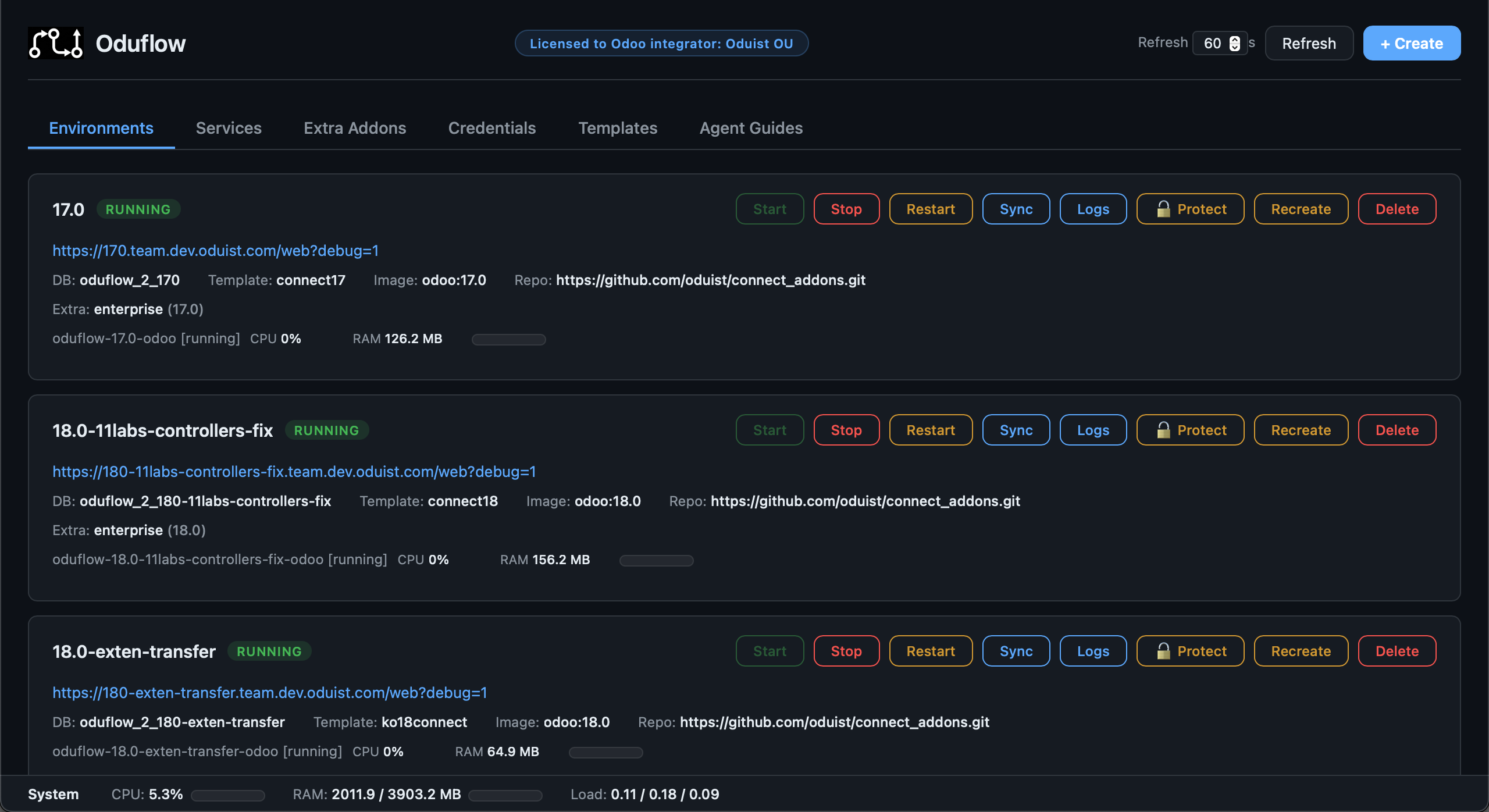
Dashboard & REST API
Manage everything from a built-in web dashboard or a full JSON HTTP API.
-
CLI Tooling
Use
oduflow callfor local in-process execution oroduflow clientfor a remote authenticated server from terminals, scripts, and CI pipelines.
Beyond Vibe Coding: Spec-Driven Development
Vibe coding — chatting with an AI and eyeballing the output — was the first wave. It works for prototypes, but breaks down on real ERP systems where a module must install cleanly, pass tests, and work against production data.
Spec-Driven Development (SDD) is the next step: you write a precise specification of what the module should do, and the AI agent autonomously implements how — because it has a closed feedback loop with the running system:
┌──────────────────────────────────────────────────────┐
│                    AI Agent                          │
│          (Cursor, Cline, Amp, Claude, …)             │
└──────┬──────────────────────────────▲────────────────┘
       │ 1. Read spec                 │ 5. Read errors,
       │ 2. Write code                │    fix code,
       │ 3. Install module via MCP    │    retry
       │ 4. Click-test UI via         │
       │    Playwright MCP            │
┌──────▼──────────────────────────────┴────────────────┐
│               Oduflow (MCP Server)                   │
│  • install_odoo_modules → traceback or success       │
│  • run_odoo_tests → test pass/fail with details      │
│  • get_environment_logs → runtime errors             │
│  • upgrade_odoo_modules → upgrade output             │
├──────────────────────────────────────────────────────┤
│            + Playwright MCP / other tools            │
│  • Navigate Odoo UI, click buttons, fill forms       │
│  • Verify business logic end-to-end                  │
│  • Validate acceptance criteria from the spec        │
└──────────────────────────────────────────────────────┘
The agent writes code, installs the module, reads the traceback, fixes the error, retries — and when it installs cleanly, it can open the browser via Playwright MCP to click through the UI, verify business flows, and validate acceptance criteria — all without human intervention. connect_as_user closes the last gap: it mints a passwordless Odoo session and hands back the cookie, so Playwright lands past /web/login as any role (admin, sales manager, portal) — no credentials to type, no login form.
| Vibe Coding | Spec-Driven Development | |
|---|---|---|
| Input | Conversational prompts | Formal specification with acceptance criteria |
| Feedback | Human eyeballs the code | System returns errors, test results, and UI state automatically |
| Iteration | Human copy-pastes errors back | Agent retries autonomously via MCP |
| Scope | Single files, prototypes | Full modules against real databases |
| Verification | "Looks right" | Module installs, tests pass, UI works on production data |
Key Features
Core
- One command to provision a fully working Odoo instance for any git branch
- Instant environment creation from large production databases via PostgreSQL templates and overlayfs
- Minimal disk footprint — environments share the template DB and filestore; only per-branch changes consume additional space
- Template-free mode — create environments from scratch (
template_name="none") when no production dump is available - Auto branch creation — if a branch doesn't exist on the remote, Oduflow clones the default branch and creates the new branch automatically
- Extra addons repositories — mount shared addon repos (e.g. Odoo Enterprise) into environments via git worktrees;
addons_pathis auto-merged intoodoo.conf - Environment protection — protect environments from accidental deletion via a toggle in the dashboard or REST API
Smart Automation
- Smart pull —
pull_and_applyanalyzes changed files (manifest, Python fields, security XML, JS) and automatically decides whether to install, upgrade, restart, or do nothing - Auto-install dependencies —
.oduflow/requirements.txt(pip, falls back to the repo root) and.oduflow/apt_packages.txt(apt) are automatically installed when creating an environment - Custom odoo.conf — if the repository contains an
odoo.confin its.oduflow/directory, it is used instead of the default template - Field change detection — Python files are analyzed for
fields.*definition changes, triggering module upgrades only when necessary
Infrastructure
- Auxiliary services — managed sidecar containers for Redis, Meilisearch, Elasticsearch, or any other service your Odoo setup needs
- Sidecar PostgreSQL storage — persistent team-scoped databases with dedicated roles, password rotation, quota accounting, and declarative Stack wiring
- Traefik auto-HTTPS — optional reverse proxy with Let's Encrypt certificates for production-like access
- Stable port registry — port assignments are persisted in
ports.jsonand survive container restarts - Resource monitoring — per-container CPU and RAM stats, plus system-level metrics (memory, load average)
Integration
- AI-agent friendly — the server exposes tools via Model Context Protocol (MCP), so LLM-based coding agents (Cursor, Cline, Amp, etc.) can provision and manage Odoo environments programmatically
- Hosted coding agent — an opt-in, per-team AI agent (Claude Code / OpenAI Codex / OpenCode) with a browser Agent Chat and Agent CLI, driving environments through MCP (see Coding Agent)
- Web dashboard — a built-in HTML dashboard for managing environments from a browser
- REST API — full JSON API for programmatic control from any HTTP client
- CLI tools — call every MCP tool locally via
oduflow callor remotely via the schema-drivenoduflow client - Dual transport — stdio (default, for local MCP clients) and HTTP (Streamable HTTP, for remote/multi-user)