MCP Tools Reference
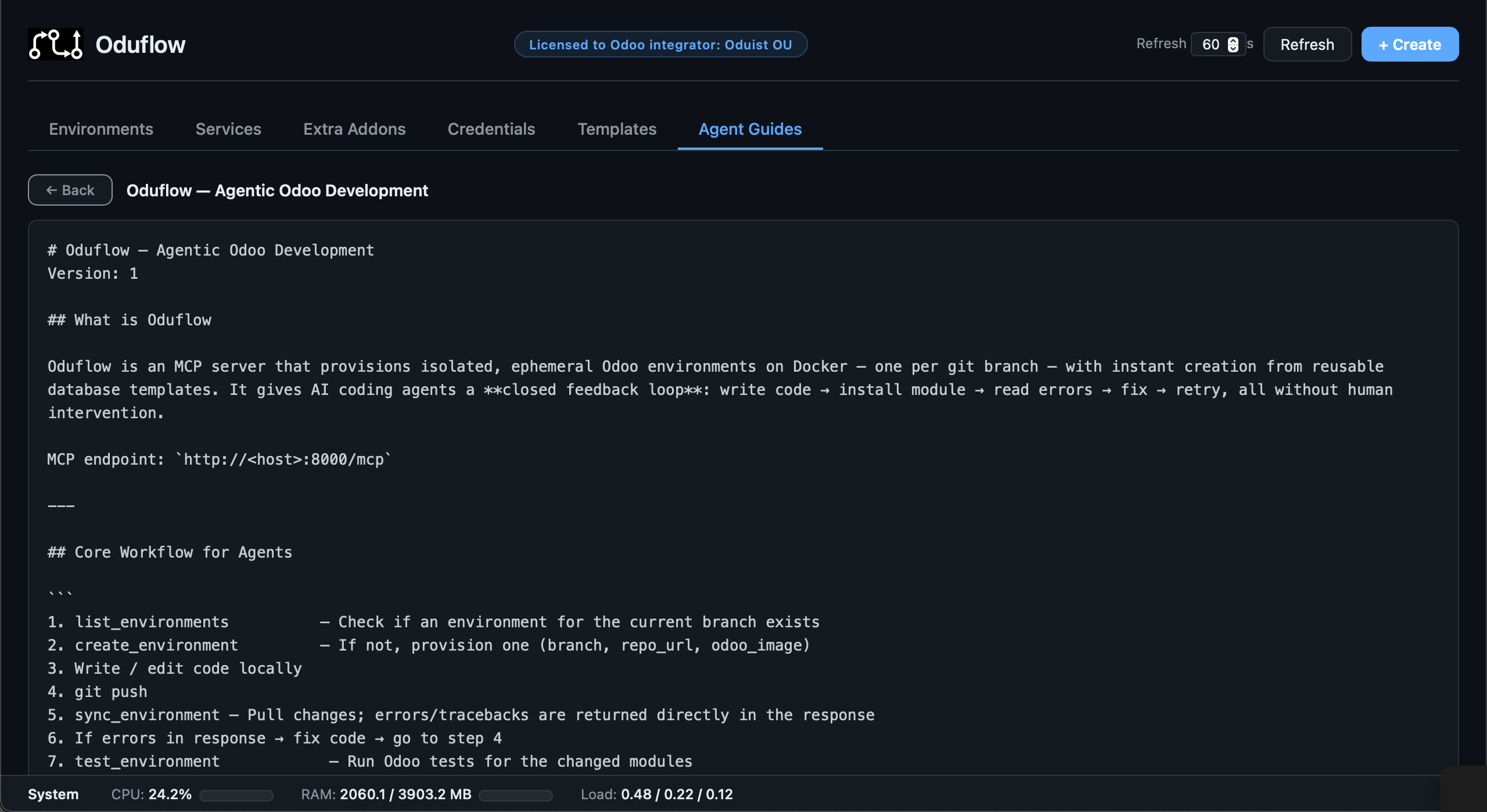
All tools are accessible via MCP clients (Cursor, Cline, Amp, etc.), locally via
oduflow call, and on a remote Oduflow server via oduflow client. A subset is
also available via the REST API.
| Tool | Lock | Description |
|---|---|---|
| Environment Management | ||
create_environment |
✓ | Provision an Odoo environment for a branch (clone, DB, container, filestore); an environment that already exists is returned as is (started if stopped) instead of raising, unless it tracks another branch; optional hostname selects a short Traefik hostname and env_vars injects container environment variables, merged per key over any recorded on the template |
delete_environment |
✓ | Tear down all resources for a branch |
list_environments |
List all managed environments with status, URL, current git branch, creation/last-activity/stopped timestamps, stop source, protection, Stack ownership and operator note | |
get_environment_info |
Full environment details: lifecycle/reuse metadata, DB name, URL, repo, image, template, extra addons, workspace, container status, CPU/RAM stats | |
start_environment |
Start a stopped environment | |
stop_environment |
Stop a running environment | |
restart_environment |
Restart the Odoo container | |
update_environment |
✓ | Re-create the container, preserving DB and filestore; optional odoo_image switches the image, env_vars replaces the container environment variables and new_name renames the environment |
switch_branch |
✓ | Point an existing environment at another branch and apply the difference, keeping its database, filestore, hostname and URL — the way to work when the team is out of environment slots; optional new_name renames the environment in the same operation (its scoped MCP endpoint moves with the name) |
| Odoo Operations | ||
pull_and_apply |
✓ | Git pull + smart analysis → auto install/upgrade/restart; summary_only=True returns one action/status line and caches command logs for read_output |
install_odoo_modules |
✓ | Install Odoo modules (-i) |
upgrade_odoo_modules |
✓ | Upgrade Odoo modules (-u) |
export_module_translations |
✓ | Export a module's .pot/.po with Odoo's own exporter, write it into the module's i18n/, and return a summary plus an HTTP download URL or local temporary path |
translation_status |
✓ | Verdict per language (OK, PARTIAL, NOT LOADED, NOT TRANSLATED, IMPORT SILENTLY DROPPED, IMPORT ABORTS, NO FILE, NOT ACTIVATED) from the module's terms, the database and the committed .po files, including the sibling-POT metadata merge Odoo performs before import, plus the call that fixes it |
run_odoo_tests |
✓ | Run Odoo tests for specific modules; summary_only=True returns the final N failed, M error(s) of K tests line and an output_id; test_tags narrows the run, while upgrade=False skips -u for a fast post_install re-run |
get_environment_logs |
Retrieve recent container logs | |
run_odoo_command |
✓ | Execute an arbitrary shell command inside the Odoo container (runs through sh -c, so pipes, redirections and && work; shell=False for exact argv) |
run_odoo_shell |
✓ | Execute Python code in the Odoo shell context with full ORM access; auto_commit=True commits successful writes, while False leaves the shell transaction uncommitted |
odoo_search_read |
Search and read records (XML-RPC search_read/search_count) as any user, with ACLs and record rules applied |
|
odoo_create |
Create one or many records (XML-RPC create). Committed immediately |
|
odoo_write |
Update records (XML-RPC write). Committed immediately |
|
odoo_unlink |
⚠️ Delete records (XML-RPC unlink). Committed immediately, not recoverable |
|
odoo_call |
Call public model methods not covered by the dedicated CRUD tools (read_group, name_search, action_*, …) |
|
odoo_schema |
Page through models, or describe one model's fields (XML-RPC fields_get) |
|
read_file_in_odoo |
Read a text file or list a directory inside the Odoo container. Supports line ranges (e.g. "1:50") |
|
write_file_in_odoo |
✓ | Write a text file inside the container (CSV imports, scripts, configs) |
search_in_odoo |
Search for a pattern (fixed-string grep) in files inside the Odoo container | |
http_request_to_odoo |
Make an HTTP request to the running Odoo instance (test controllers, JSON-RPC, REST) | |
list_installed_modules |
List Odoo modules and their states with name/state filtering | |
run_db_query |
✓ | Execute SQL against the environment's PostgreSQL database; supports output_format="csv" or "json" and caps returned rows with max_rows (default 100) |
reset_admin_password |
✓ | Reset the admin user password in the Odoo database (default: "test") |
connect_as_user |
✓ | Mint a passwordless Odoo login session for a user (by login or id) and return the session_id cookie + URL — hand to Playwright to skip the login form and test as any role (incl. portal) |
read_output |
Read from a cached tool output by ID (paginate, grep, errors, tail) | |
| Template Management | ||
save_as_template |
✓ | ⚠️ Save a branch DB + filestore as a new template |
list_templates |
List available template profiles, including the branch/commit each database snapshot was taken from | |
delete_template |
✓ | ⚠️ Delete a template profile (DB + files) |
rename_template |
✓ | Rename a template (directory + PostgreSQL template DB); refused if any environment uses it |
import_template_from_odoo |
✓ | Import a template from a running Odoo instance via database manager API; optional without_filestore requests a database-only PostgreSQL custom dump |
refresh_template |
✓ | ⚠️ Re-apply a template's filestore to live overlay environments (preserves env changes by default; reset_env_changes=True discards them — destructive) |
attach_filestore |
✓ | Attach or replace a template filestore from a local directory, archive, rsync:// URL, or SSH rsync source; normalizes wrapper paths and preserves live env changes by default |
| Auxiliary Services | ||
create_service |
✓ | Create a managed service with exactly one exposure model: catch-all port, or restricted Traefik routes (path, backend port, optional strip_prefix). The two parameters are mutually exclusive; port remains required outside Traefik. Optional command (shell-quoted string) replaces the image CMD |
delete_service |
✓ | Stop and remove a service container |
restart_service |
✓ | Restart a service container |
update_service |
✓ | Preflight configuration, pull the latest image and/or change settings. routes replaces the complete allowlist; use routes=[] with port only when switching back to catch-all mode. command is tri-state: omitted keeps it, a string replaces it, an empty string falls back to the image CMD |
list_services |
List all managed service containers | |
get_service_info |
Full live state of a single service (image+digest, port/routes, hostname, host_mode, command, volumes, env, capabilities, restart count, preset). Call before recreating it | |
get_service_logs |
Retrieve service container logs | |
run_service_command |
✓ | Execute a shell command inside a service container (through sh -c; shell=False for exact argv) |
| Service PostgreSQL Databases | ||
create_service_database |
✓ | Create a persistent team-scoped PostgreSQL database with a dedicated non-superuser owner; returns DATABASE_URL and PG* credentials |
list_service_databases |
List database names, live status, size, and connections without passwords | |
get_service_database |
Explicitly reveal connection credentials for one managed database | |
rotate_service_database_password |
✓ | Rotate the owner password and return replacement credentials; containers must be reconfigured |
delete_service_database |
✓ | ⚠️ Permanently drop the database and role after terminating active connections; service containers are unchanged |
| Volumes | ||
create_volume |
✓ | Create a named Docker volume for use with services |
list_volumes |
List all managed Docker volumes and their usage by services | |
inspect_volume |
Get detailed information about a specific volume | |
delete_volume |
✓ | Delete a managed Docker volume (fails if in use) |
read_file_in_volume |
Read a text file or list a directory inside a Docker volume | |
write_file_in_volume |
✓ | Write a text file inside a Docker volume |
search_in_volume |
Search for a pattern (fixed-string grep) in files inside a Docker volume | |
delete_file_in_volume |
✓ | Delete a file or directory inside a Docker volume |
| Service Presets | ||
list_service_presets |
List saved service presets (configurations that can be restored) | |
restore_service |
✓ | Restore a service from a saved preset |
delete_service_preset |
✓ | Remove a saved service preset |
| Secrets | ||
list_secrets |
List the names of the team's named secrets; values are write-only (set in the dashboard) and are never readable over MCP. Reference one in any env_vars argument as KEY=secret:<name> |
|
| Container Image Builds | Requires a [team.X.image_registry] section |
|
start_image_build |
✓ | Build a container image from the environment checkout's current commit (asynchronous; returns a build_id); the source is sealed with git archive under the environment lock, with hard timeout, log-size, and per-team concurrency limits |
get_image_build |
Status, source commit, publication history, and a build log tail for one build | |
publish_image_build |
✓ | Push a succeeded build's exact image (never a rebuild) to comma-separated tags — latest, semver, anything valid — under the team's configured registry namespace; per-tag outcomes, last-writer-wins |
cancel_image_build |
Terminate a running build and its Docker connection, including a silent Dockerfile step | |
| Repository Auth | ||
setup_repo_auth |
✓ | Cache git credentials for a private repository |
| Extra Addons | ||
add_extra_repo |
Clone an extra addons repository (e.g. Odoo Enterprise) for use with environments | |
list_extra_repos |
List all cloned extra addons repositories | |
update_extra_repo |
Fetch latest changes from the remote for an extra addons repository | |
delete_extra_repo |
Delete a cloned extra addons repository | |
| Production Hosting | Requires [production].enabled = true |
|
create_production |
✓ | Provision a long-lived production with its own domain and the dedicated production PostgreSQL cluster; optionally seed it from a template |
list_productions |
List productions with status, domain, deployed commit, and auto-update state | |
get_production_info |
Detailed status, configuration, deployed commit, deploy history, and backup information | |
start_production |
✓ | Start a stopped production |
stop_production |
✓ | Stop a production, taking it offline |
restart_production |
✓ | Restart a production's Odoo container |
set_production_auto_update |
✓ | Enable or disable GitHub push webhook deployments |
update_production |
✓ | Deploy pulled commits with explicit/automatic actions, health verification, and automatic code rollback on failure |
rollback_production |
✓ | Roll production code back to a selected commit and restart it; does not roll back the database |
production_deploys |
Read deploy history, including actions, modules, trigger, and rollback status | |
production_logs |
Read production Odoo logs with line, substring, and level filtering | |
snapshot_production |
✓ | Create an S3 snapshot containing the database, deduplicated filestore, and deployed commit |
list_production_snapshots |
List S3 snapshots; refresh=True bypasses the cached index |
|
restore_production |
✓ | Restore one production's database and filestore; requires its name in confirm |
production_backup_status |
Inspect snapshot schedules, WAL archiving, base backups, and S3 reachability | |
set_production_backup_schedule |
✓ | Set a production's daily snapshot time (HH:MM) or disable it with off |
prune_production_backups |
✓ | Apply configured snapshot and chunk-store retention immediately |
restore_cluster_pitr |
✓ | ⚠️ Restore the entire production PostgreSQL cluster from WAL-G; requires confirm="RESTORE-CLUSTER" |
delete_production |
✓ | Remove a production; requires its name in confirm, and preserves its database unless drop_database=True |
| Agent Instructions | ||
get_agent_instructions |
Load the compact Oduflow agent workflow once at the start of a session | |
get_odoo_development_guide |
Get Odoo development standards guide for a specific version (15–19) | |
| Feedback | ||
report_issue |
Build a prefilled link for the user to file a bug, feature request, or feedback about Oduflow on GitHub |
Locking
Tools marked with ✓ acquire a lock on exactly what they touch: the branch, one service, one volume, the team's credential store — or the whole team, for the few operations that really are team-wide (template publishing). Operations on different resources run in parallel. If another operation on the same resource is already in progress, the call is rejected with BusyError. The rejection names the operation holding the lock and how long it has held it (e.g. "Another operation on environment 'main' (pull_and_apply, running for 4m12s) is in progress"), so a long install is distinguishable from a hung one. A lock is released when its operation finishes — including when the client that started it timed out and stopped waiting, which is why restarting the environment is the wrong response.
The exact current signature and defaults for every tool are also available from
oduflow list (oduflow list --verbose adds descriptions). The production
workflow and disaster-recovery consequences are covered in
Production Hosting.